


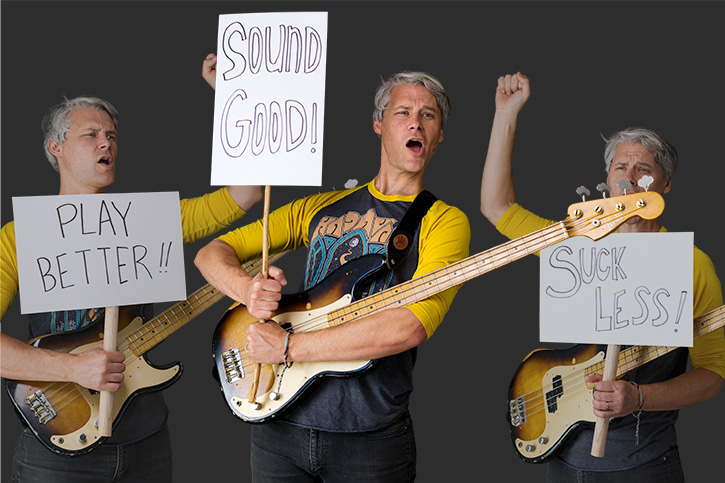
Anyone can put some time in on a language app and head on over to Italy. But just because the app gave you 10,000 points, a big trophy and 17 achievement badges… doesn’t mean your Italian is sounding great to a native speaker.
It’s the same on bass.
Anyone can go online, order up an instrument, watch a few videos in their room, and then rumble out into the musical world doing the electric-bass equivalent to a brutal, ignorant newb-on-bass accent.
With this article I’ll address 5 of the most common (and most easily fixed) beginner bass mistakes that you’re probably making.
My teacher always told me, “awareness cures” – you can’t fix it if you don’t know what to fix.
By the end of this article you’ll know what to look for and how to fix it.
Onward to better bass playing!
#1Anchor Your Thumb
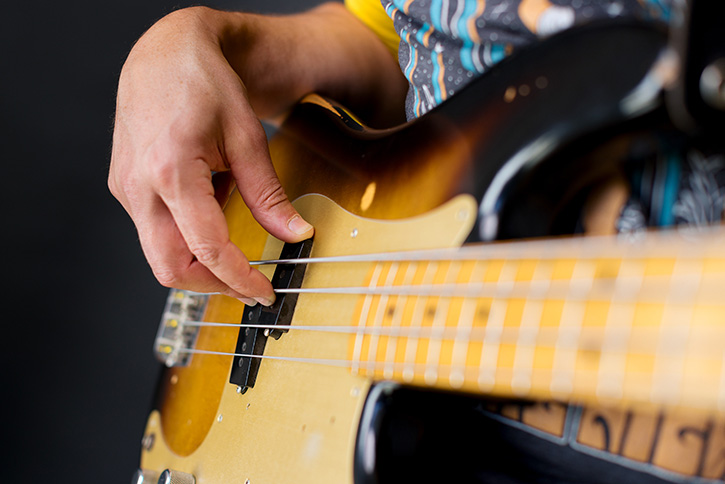
If you don’t know any better, you might have your thumb doing all kinds of wild things over there on your plucking hand.
In my experience, thumb behavior has included (but is not limited to):
- Just kind of floating around, aimless, like a ghost
- Hooked over the top of the bass body
- Tense and jammed out like you’re simultaneously hitchhiking and playing bass
- Shoved, like a tent pole, into the bass body somewhere between the pickups and the top of the bass body
 This is INAPPROPRIATE thumb behavior.
Appropriate plucking hand thumb behavior:
Anchor your thumb on a pickup or on a low string at all times.
This will help you:
 find the strings.
keep the bass stable so you get solid plucks.
keep low strings muted.
But wait… what if you have a solidly anchored thumb, but – for reasons unknown – your plucking still sounds like angry farts, or like twangy whispers?
Time for…
#2Pluck Like Goldilocks
Time to pay attention to how you pluck.
A common beginner mistake is either plucking too hard or too soft.
 Too hard = angry farts.
Too soft = twangy whispers.
(I’d go see either of those bands, by the way.)
When you get the plucking approach and intensity just right, it will sound clean, solid, round, warm, beefy, satisfying, and lots of other words used to describe ideal bass tone.
To get this sound, it is very important that you apply the right amount of pressure in the correct way!
 First of all, to pluck properly, you have to pluck ACROSS and not UP.
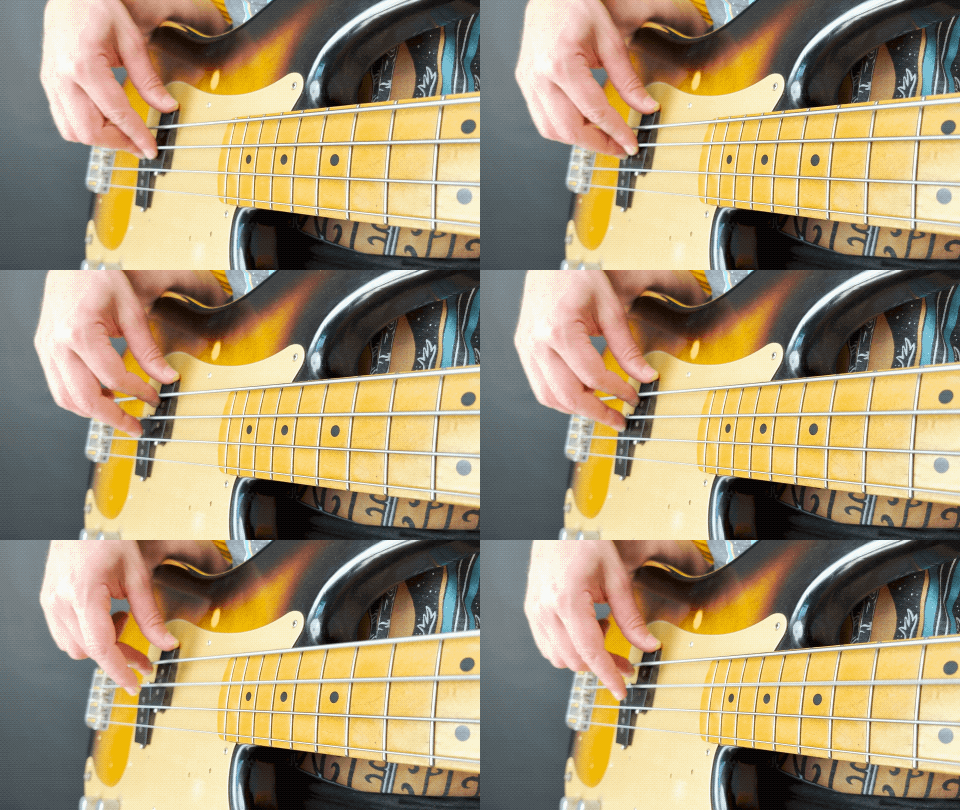
Now to truly bring your awareness to these variations and horrible potential plucking outcomes, try an experiment.
Try to make the sound of angry farts by plucking far too hard.
Now stop.
Try to make the sound of twangy whispers by softly (oh so softly) plucking up and away on your strings like some kind of harp player from a fantasy movie.
Now stop.
Promise to never do that again.
Now pluck, with an appropriate amount of force, across the string (like the GIF above).
That’s it!
Never stop doing that.
Learning this tip is the bass equivalent to learning how a foreign language is pronounced and spoken by native speakers.
This, more than anything else, will bring your bass sound into the world of legitimate bass playing.

For all the ways to sound like a legitimate bassist, check out our complete beginner bass course.
#3It’s Not About the Gear
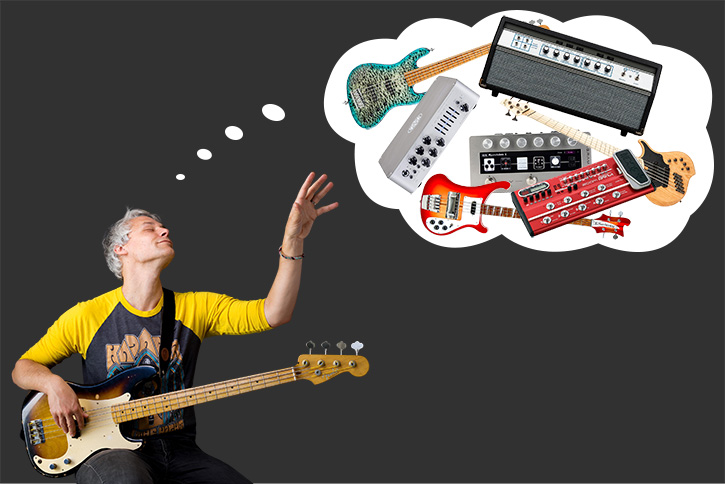
There is a one-to-one comparison to make here on an inexperienced bassist with new, expensive gear and someone buying a new and expensive Italian wardrobe in their efforts to fool the native Italians.
It will work so long as you don’t make a sound.
A lot of beginners make the mistake of spending way too much time worrying (drooling over, clicking on, dreaming) about gear.
A piece of news that is both liberating and devastating:
Your sound comes primarily from YOU, not your gear.
Liberating, because now you don’t have to max out another credit card getting sweet, sweet new gear to try and catapult yourself into the next level of bass playing.
Devastating, because now you can’t max out another credit card, get sweet, sweet new gear, and – by buying things – catapult yourself into the next level of bass playing.
Cheap gear, within reason and with a decent setup is absolutely good enough for most playing scenarios. Particularly live shows, rehearsals, gigs and any situation where your bass is competing with drums, guitars, vocals and, probably, some sports game on the bar TV that – due to general disregard for musicians and our tender feelings – is still on with the volume up while you play.
You don’t need to wait for that next piece of amazing gear to sound like a legit bass player – it’s all about you and how you play.
#4Use The Mighty Pinky
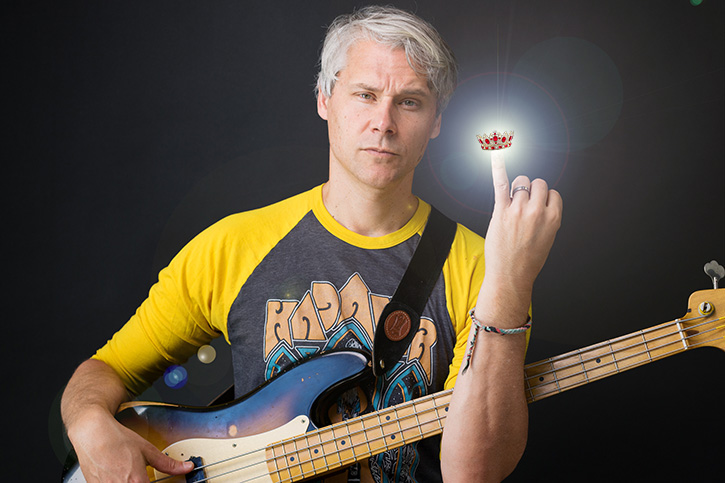
Yes, if you play bass you need to fret with your pinky.
This is super important and is one of the most common bass mistakes beginners make!
I get it.
The pinky is small, tiny, and just kind of hangs there at the end of your big, coordinated, robust other fingers.
And now you’re asking it to do all sorts of independent and fancy things.
There will be – for all players – a period of pinky-suckage-time (PST). This is normal.
You have to work through this and get the pinky in the mix.
With practice it will become just as STRONG and DEXTEROUS as the rest of your fingers and you’ll be able to play cleaner and faster.
You only have four potential fingers to fret with. If you eliminate one of those fingers, you have just lowered your max fretting potential to, in a best case scenario, 75%.
Don’t settle!
Use 100% of your options! Be patient with your pinky and it will become a valiant and trusty ally in your quest for non-noob bass playing.

Check out our completely free Kickstart Course! (A worthy side quest on your mission for non-noob playing.)
#5You Won’t Suck Forever
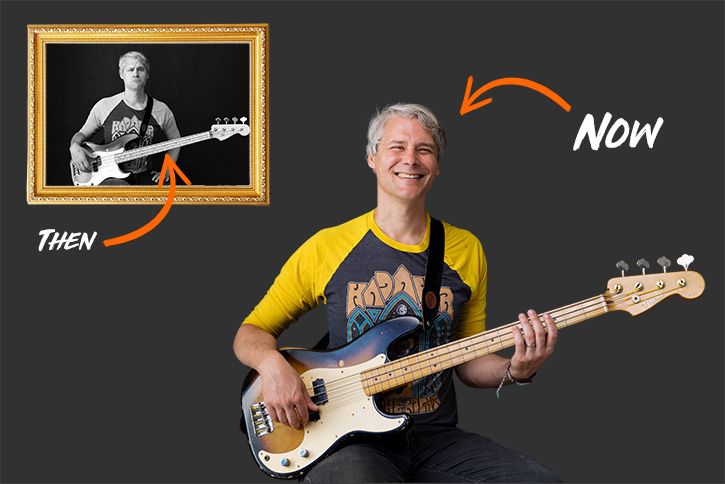
Important breaking bass news:
You DON’T need talent to learn bass.
As Geoff Colvin details in his excellent book, Talent is Overrated, what separates seemingly ‘talented’ musical superstars from the rest of us is just putting time into deliberate practice.
It doesn’t matter if you identify as a ‘slow learner’ either. In my years as a teacher, every student has always made progress regardless of learning speed… so long as they took the time and carved out those minutes for deliberate practice.
Random noodling is not necessarily deliberate practice, though it is quite fun (see bonus tip below). It is important. But if improvement and leveling out of the beginner-bass-player status is a goal, make sure you have clear things to play and work towards to turn your practice time from random-wankage to directed, deliberate improvement.
A smart, structured practice helps you learn faster, whether you do that on your own, with a good teacher, or with some brilliant online lessons and articles (ahem, wink, cough).
#6Bonus Tip: Have More Fun
If you’re like me, and most every bassist I know, you started playing because you love music and you want to have fun playing it.
If you got into bass playing to become wealthy and popular, I am so, so sorry.
Don’t let the learning, the gatekeeping, and the supposed things a bassist should know get in your way. You can start playing now. You can have fun now. You can find songs that you like that are easy and playable now. You can find people to play and jam with now.
You don’t have to wait.
You don’t have to do any of these things first:
- Get better gear
- Learn theory
- Play perfectly
- Know all the songs
All you have to do is start, and look for opportunities at your level. You will find them.
Having fun actually helps you learn by increasing levels of DOPAMINE, ENDORPHINS and OXYGEN to your brain.
Having fun actually helps you learn by increasing levels of dopamine, endorphins and oxygen to your brain.
It is certainly easier to get through the learning obstacles and roadblocks if you have some fun experiences to lean on.
So! No waiting. Don’t should or until… yourself into a corner.
Play, have fun, and enjoy this lovely instrument.
Conclusion
Now you know.
Anchor that thumb, pluck across them strings, don’t worry about gear, use that pinky, don’t worry about sucking, and remember to have fun.
Your hideous new-bassist accent will disappear, and you will blend seamlessly into the world of fluent-music-speakers.
If you need some hands on tips or visual references for any of this, you can watch the video here.
Remember, awareness cures!
Reading this article doesn’t magically make all of these things happen – but if you know what to pay attention to, you know where to start.
Happy bass playing.
*For true folklore buffs, the brothers Grimm were also massive music-heads. They didn’t just travel around collecting folk tales, but were also in the early 1800’s heavy metal outfit “Grimm Proposition” featuring brothers Jacob Grimm on guitars and Wilhelm Grimm on bass. (Their cousin, Brumhilda Grimm, was an absolutely genius blast-beat drummer who, sadly, was written out of history because of the rampant chauvinism of the time.) In the early drafts of Goldilocks and the Three Bears, Goldilocks is depicted as a traveling, bass playing minstrel. This was edited out later, when the brothers disputed whether she (Goldilocks) should play guitar or bass, fingerstyle or pick style, and it was agreed (to keep peace among the siblings) that they should ditch the music angle all together. I mention this here only because when I write “play like Goldilocks”, I don’t mean to reference porridge, but rather the historical, bass-playing, fingerstyle plucking character of Goldilocks from the early drafts of the Brothers Grimm collection of tales. Obviously.
 Beginners Course

 4 easy steps to pro fretting and plucking
Comments
Got something to say? Post a comment below.