


The internet is a terrifying place to ask a simple, honest question.
Say, for example, you don’t know what a P bass or a J bass is. This is fair. These things aren’t covered in school (though they ought to be). If you take this question to the internet you‘ll enter a maelstrom of unnecessary history, over-the-top superlatives, and hordes of loyal and rabid P-bass-or-die fundamentalists battling the equally rabid and loyal throngs of J-bass-or-die fundamentalists.

This article is here to pull you out of that dark-bass-web tailspin.
I’m going to tell you everything a beginner would ever need to know about the P Bass and the J bass.
I’m not going to tell you which one is better, and which one makes you a w34k-455 n008.
No elitist grandstanding here.
I love these basses and I want to share that love and heaps of reasonable, practical information with you.
Let’s start at the very beginning.
What, even, is a P or J bass? What are these mysterious one-letter names all about? Did Leo Fender make basses alphabetically and basses A-I, and K-O were all garbage?
Read on to demystify all things P and J.
#1What Are P and J Basses?
P Bass = PRECISION Bass

Who has time to say long words anymore? No one, that’s who.
A “P bass” is an abbreviated name for a Precision Bass.
Fender put out their first ever Precision bass in 1951, which was redesigned in 1957 to bring us what we recognize as the P bass today. It was the first time* bassists could plug in and get super loud, and the first time they got frets. Before this it was allll upright bass, baby.
And if you’ve ever played anything acoustic and without frets, you’ll know why this new instrument was called “Precision”. In tune notes! Clear loud notes! It was a whole new, louder, much more precise, bass world.
J Bass = JAZZ Bass

The “J bass” is an abbreviation for Jazz Bass.
It’s the same number of syllables, but take it from the guy typing over here – if you can save yourself a few azz’s, it’s worth it.
The Jazz bass was released in 1960.
It was not created to play Jazz. It was not commissioned by Jazz players. It did not have any real affiliation with the Jazz genre or Miles Davis or John Coltrane. It was created to be a deluxe new instrument – a new, sexier option to the Precision Bass. Luckily, in addition to its sleek marketability, the J bass had all kinds of changes that were musically important to us bass players. I’ll get into that more later.
History lesson – done.
Now that you know when they were made… who cares about these instruments? Why are bassists and the bass internet always full of P-bass this and J-bass that?
In other words…
What’s the Big Deal With These Two Basses?
The birth of rock and roll, soul, funk, metal and just about every electric bass genre of music had its classic, defining period somewhere between 1950 and 1970.
During that time, the Fender P bass and the Fender J bass dominated the world of recorded music.
Because the DNA of electric bass sounds – the holy pantheon of electric bass tone – comes from this time period, it also tends to reference these instruments.
The Fender Precision and Jazz basses are all over the most important recordings by the most famous and influential bands of every era, but particularly those early rock-and-pop defining years.
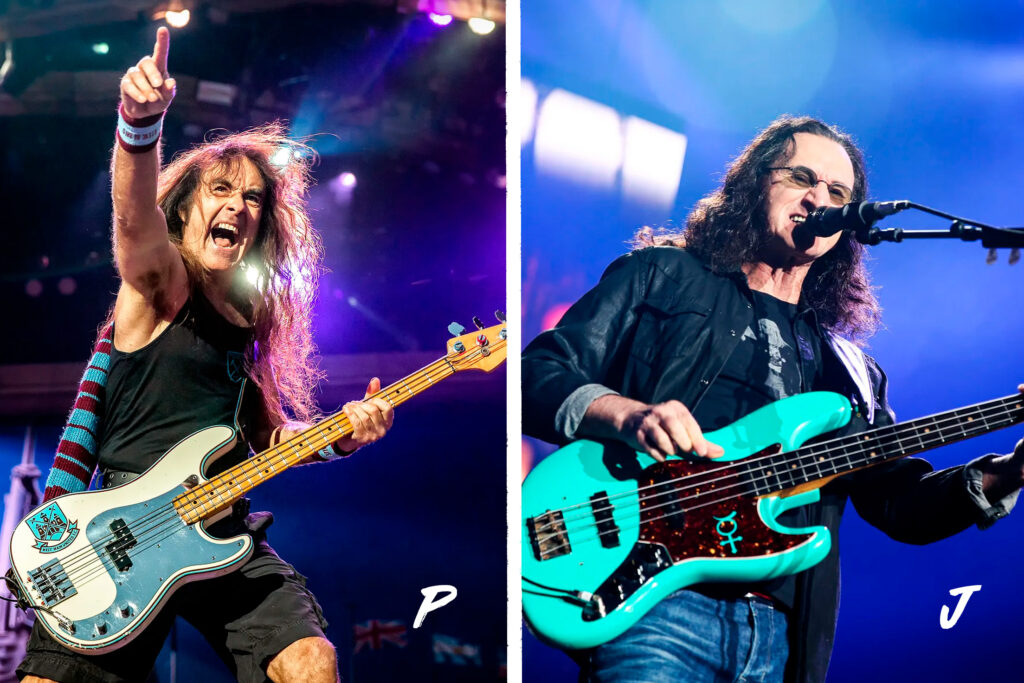

Now that you’re stoked on this shot of Steve and Geddy, check out our complete beginner bass course!
As a result, if you are a bassist who is hired for a recording session, it is assumed that you are going to show up to record with a P bass and a J bass. You can bring your weird, fancy, custom 6 string if you want, but know that it will probably stay in the case**.
And it’s not just hype or some nostalgic, romanticization of the past. These instruments sound amazing.
But even if you’re like me and – for decades – you just don’t get it (I really hated P basses and J basses for the first 15 years of my bass life!) and you insist on bringing your graphite-neck 5 string super slick, ultra-modern and fancy bass to every gig and recording session… you will be ever-more-firmly directed towards Ps and Js by producers and engineers and players because they are the sounds that work – time and time again – for specific settings, sounds and genres.
Given all the hype and praise, I’m hoping you’re asking the question “gee… what do these basses sound like?”. Because that’s what I’m about to answer.
Kind of.
#2What Do They Sound Like?

This is the impossible thing to write about. This is where you have to get directly to the real deal, the genuine article! The horse’s mouth!!
Words aren’t going to get these sweet bass sounds in your ears, so instead I am just going to point out 9 of the iconic, must-listen-to players as categorized by the model bass that they’re playing. As you get out there and put your ears on their very excellent and righteous playing, let me tell you this very, very important thing:
 If you can’t hear any difference at all between these two different electric basses that is ABSOLUTELY FINE.
If you gave me a blind taste test and wanted me to identify different wines, I’d fail. At first. Probably at second and third and 15th as well. But in time, and with some personal experience, I’d get better.
You will get better the more you listen and actively encounter these two instruments.
Eventually, you’ll be able to identify the different characteristics in sound more easily and more specifically.
Behold the basses in their natural habitats:
P Bass Examples

J Bass Examples

If you’d like to hear those two basses in a much more isolated context in a wonderful video designed specifically to show you the variations and sounds of these two basses, you can click on this.
Thanks Josh.
Great, you now know the secret names of the P and the J bass, their origin story, and your ears got to taste them.
But can you identify them in the wild? Do you know on sight which is which? If it was bass hunting season, and you could only tag and bag P basses, could I trust you not to be out there poaching J basses??
Sounds like you need a field guide.
#3What Do They Look Like?
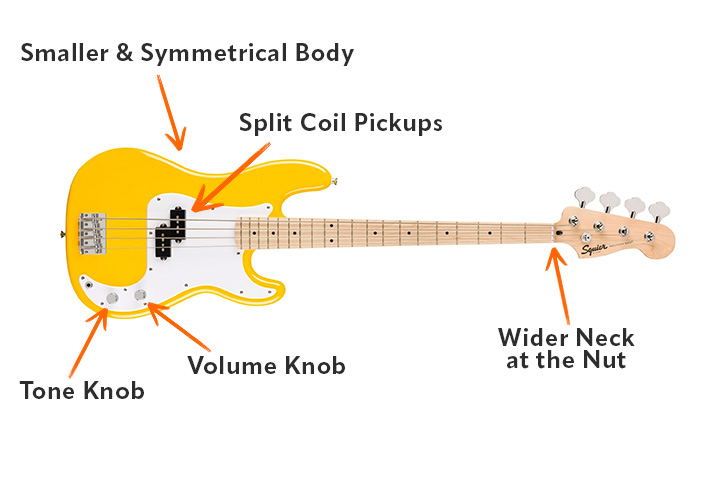
There are some very crucial identifying factors about a P bass and they are all labeled for you on the image below. Study that picture. That is the machine that birthed rock and roll and punk and Iron Maiden. It is a mighty, mighty machine.
And now – the J bass. Feast your eyes on its sleek, curvaceous body!
This has been the weapon of choice for the ultimate bass shredders and, fittingly, the most adopted into the world of jazz.
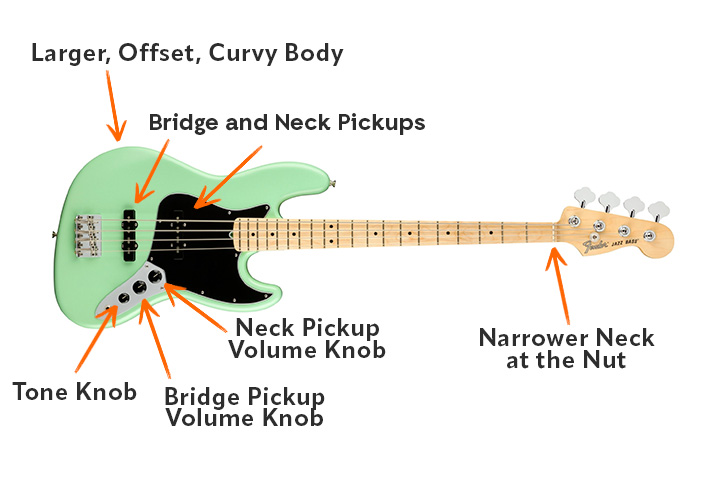
You’ll notice differences right away. Each visual difference translates to a difference in some aspect of bass playing.
Differences in bass playing? Like what, Gio?
Well, I’m so very glad you asked.
#4What Makes These Basses Distinct?
The Pickups
The first thing to notice between the P bass and the J bass is the difference in pickups.
Pickups are those mystical, magical (to me, anyway) devices that sit under the strings by your plucking hand. They take the sound from your strings and transport it into an AMPLIFIER.
How? Magic.
Let’s move on.
 P Bass Pickups
The P bass has one pickup split up into two squat rectangles that are set right smack in the middle of the bass body. There are two knobs down there. One of them controls the volume for that single pickup and the other one controls the tone.
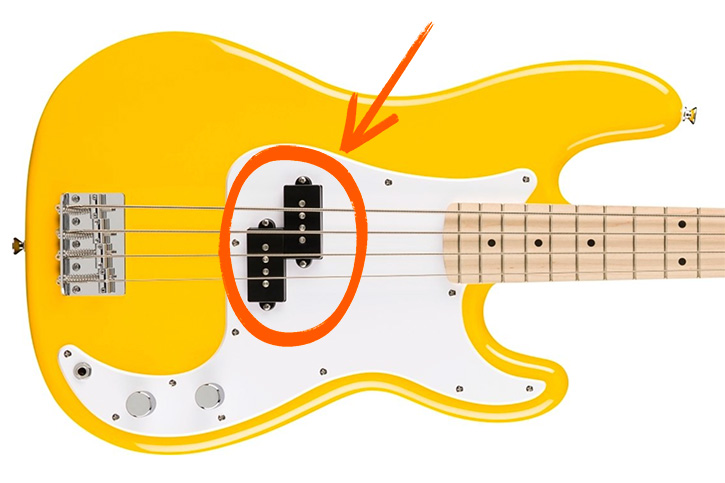
The sound the P bass makes is dictated by this one pickup in this one place.
It is the classic sound of electric bass playing dominating all the works of Stax, Motown, classic country, classic punk and more.
When people (self included) talk or write about the classic sound of the P bass we use words like:
- Growly
- Punchy
- Fat
- Warm
- Round
- Mid-rangey
These goofy words are a weak approximation.
Just like you don’t know what a wine tastes like from those ludicrous tasting notes on the back.
Hints of wild cherry and campfires?? Come on.
But the words are the best I have on this side of the screen. Hopefully when combined with the recorded examples from up above, it will make some sense.
J Bass Pickups
The J bass has two long rectangular pickups: one set right close to the bridge (the place where your strings anchor to the body of your bass) and one closer to the neck of the bass. There are three knobs on the J bass. One knob to control the volume of each respective pickup, and one knob for tone.
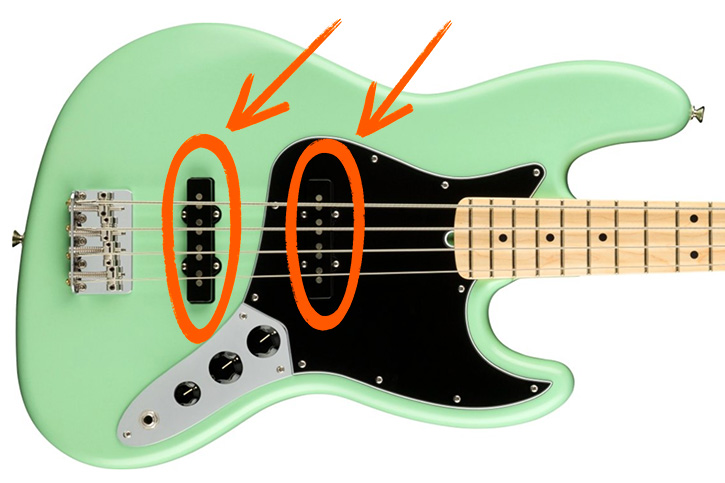
The 2 pickups on this bass design are the biggest bass-sound game changer.
Because the neck pickup (the pickup closer to the neck) is in the general area that the P bass pickup is, you can use only the neck pickup to try and capture some of that same warm, growly, punchy sound of the P bass. It’s not quite the same, but it is similar.
And then you have the J Bass secret weapon – the bridge pickup (the pickup closer to the bridge). This pickup – because it is so close to that point of extremely high tension where the string meets the bridge – has a very bright, articulate and almost quack-y sound.
 Using different blends of these two pickups gives the Jazz bass a WIDE RANGE of sound options.
And while the Jazz bass can get close to approximating the sound of that middle P bass pickup, the P bass cannot get close to the very bright, singular sound of that Jazz bass bridge pickup.
When people are describing J bass tone, they will use words like:
- Scooped (lots of highs and lows, less mid range)
- Articulate
- Bright
- Punchy
- Quacky

When people describe our Kickstart Course they use words like: excellent, super helpful, and totally free.
Better pickups? Worse pickups? Better sound? Worse sound?
I can’t tell you that.
It all depends on what you’re going for.
I like them both, and for different reasons.
Again, it’s all about what sounds good to you, and I don’t know what that is.
And, to be fair, it’s not just about what sounds good to you. It’s also about looks. I am secure enough to admit that my first bass was purchased 100% on looks (it was all black, and I was into METAL!!).
This brings us to hot and hunky bass bodies.
The Body
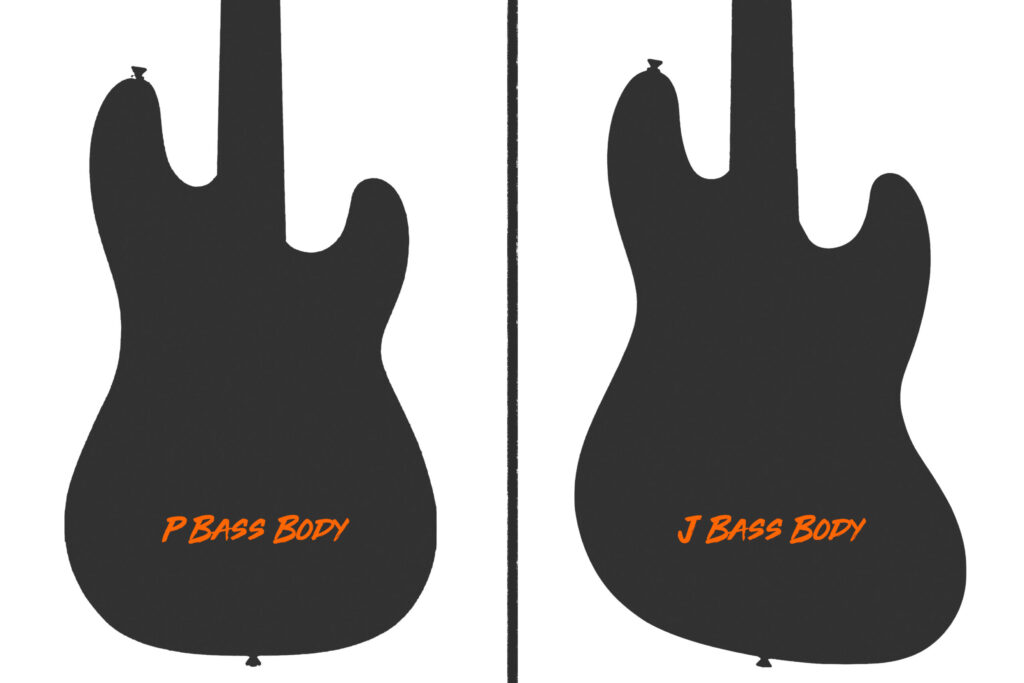
The Precision body is pretty symmetrical. The horns are different lengths, but the body is otherwise fairly balanced.
Not so the Jazz Bass! It has an offset, non-symmetrical, super-curvy body shape. This was to suggest the deluxe and fancy qualities of the instrument and to differentiate it from its more every-day looking bass sibling. The offset design makes for a larger body on the J bass. It can make the basses, on average, a bit on the heavier side when compared to the P bass.
This tiny detail – the weight of a bass – can become massively important ohhh, right around the 2 hour mark of a three hour gig where you’ve got a 12 pound hunk of wood slung on your shoulders.
There are certainly light J basses, and there are definitely heavy P basses. It changes from instrument to instrument – even instruments made out of the same types of wood.
Only you know how many pounds of bass you want to have hanging around your neck at a gig.
The body shape does not affect the sound of the bass in any significant way. And if someone comes after you about this and wants to claim that body shape/size is super important to sound because of tone wood, resonance, mass, blah-di-blah… take them to a show in a loud club / bar and ask them to tell you what part of the nigh-indecipherable rumbling sounds you’re hearing you should be attributing to the finer points of the jazz bass’s larger body.
Um, well, technically, Gio…
Don’t you dare “oh, technically” me. I’ve played too many gigs through too many sh*%#y PAs to worry about body-mass-tone-loss in my Precision bass.
Well, I’m actually a super fancy studio bassist where every tiny iota of tone is massively important to me and…
Then what are you reading this article for? Go do Tone Stuff in Tone Land with the Tone People and let me hang out with the folk who this article is for.
Sheesh.
Now if you want to talk to me about how these instruments feel in one’s hands and what bass necks work for different folks, I’ll invite you in, make you coffee, and we can speak of these important matters like civilized bassists.
The Neck
The neck is the long bit with all the frets on it.
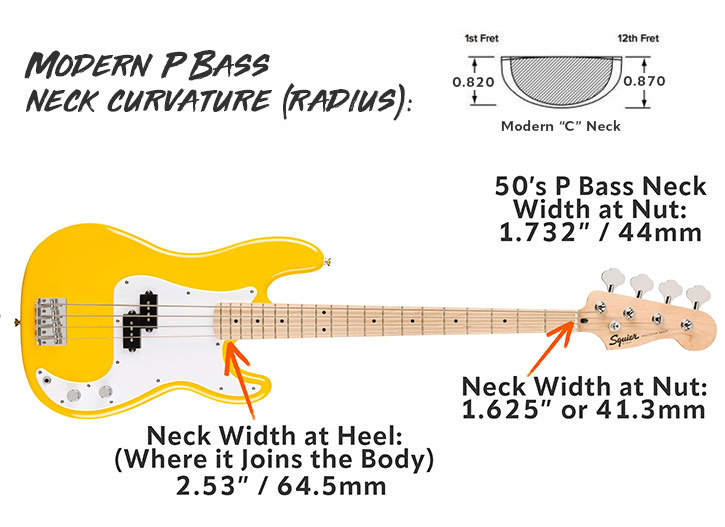
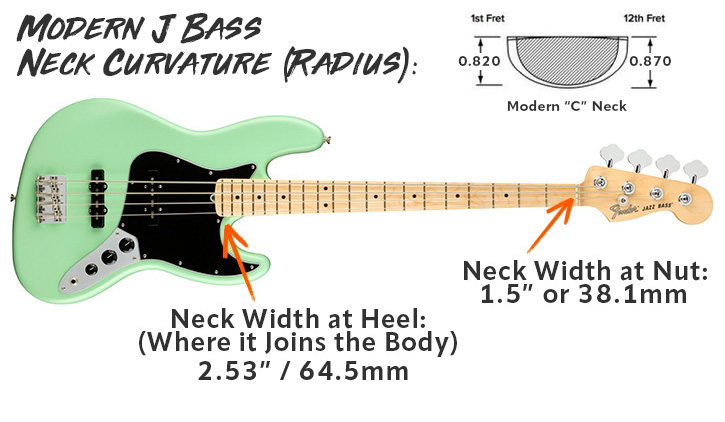
You can see in the picture how the Jazz bass neck tapers and becomes more narrow as it gets to the nut (the piece that holds the strings at the tuning-peg end of the neck).
In addition, the J bass neck through history tended to be a bit thinner (meaning from the back of the neck to the fingerboard) than the P bass neck. The modern necks are the same “Modern ‘C’ Necks”, but if you get into older basses, there are very noticeable differences.
In practical terms, these differences are very slight. However, when playing certain bass lines, the microscopic change in how far away strings are from one another and the thickness of the neck can be very significant. As a generalization, the J bass’s thinner neck and closer string spacing can make it a bit easier and quicker to move around on.
The thickness and width of the neck is 100% about how it feels to you. I have worked in music stores and have had my hands on thousands of bass necks. What bass necks feel right and good will be completely different from person to person.
The necks can even feel different from P bass to P bass, and between different J basses. The specific measurements and profiles and tapers of the necks have changed through the years as well, so a 50s P bass will be very different from a ‘69 P bass, likewise with J basses.
If you have smaller hands, you may enjoy the smaller, more tapered neck of the J bass. Or I could be dead wrong and the curvature and width of the P bass might just feel like it fits you better. Only you and your physical experience with the instrument can tell you this!
Speaking of what you might like and why – what bass is better?
Which should you use for certain genres? Which one is more legitimate? Which one is the better bass for better people? Which bass should you champion, and which one should you shit post about on bass forums????
Which Bass Is Better, P Bass or J Bass?
You know this is a trap right?
It depends.
The dreaded “it depends” strikes again!
The best bass is the one that you have. That’s ALWAYS the best bass.
Everything after that is about trying to appeal to something more specific:
- Something that you, specifically, like more (feel/weight/neck/ergonomics/etc).
- Something that is more specific to a sound that you’ve heard and want to capture.
- Something that is more specific to a classic sound of a certain genre or band.
- Something that is more specific to an aesthetic you identify with. (ie, me with my all black first bass so I could be more metal! 7th grade METAL!!)
In digging into these specifics, I can give some examples where a P bass or J bass would be objectively a better choice.
Here they are.
Objectively, a  P Bass Would Be Better if…
…you’re trying to emulate the sound of genres or players who played a P bass.
Examples of this would be:
 Anything that you want to sound pre-1960s.
 Anything recorded by Motown records.
Anything recorded by Stax records.
 Anything played by:
- James Jamerson
- Duck Dunn
- George Porter Jr. (The Meters)
- Steve Harris (Iron Maiden)
Objectively, a  J Bass Would Be Better if…
…the demands of your music world call for the sounds of genres or players who played a J bass.
Examples of this would be:
Anything played by:
- Jaco Pastorius
- Marcus Miller
- Ashton “Family Man” Barrett
Just about everything else is going to be very, very subjective.
In fact, I’m sure I’ll have plenty of people who disagree with the above attempts at objectivity. The internet abhors objectivity!
But even inside the ever-frustrating world of It Depends subjective answers, there are some guides you can follow to better determine which bass – the P bass or the J bass – would be better for you in a given scenario.
P Bass vs J Bass – the Subjective Guide
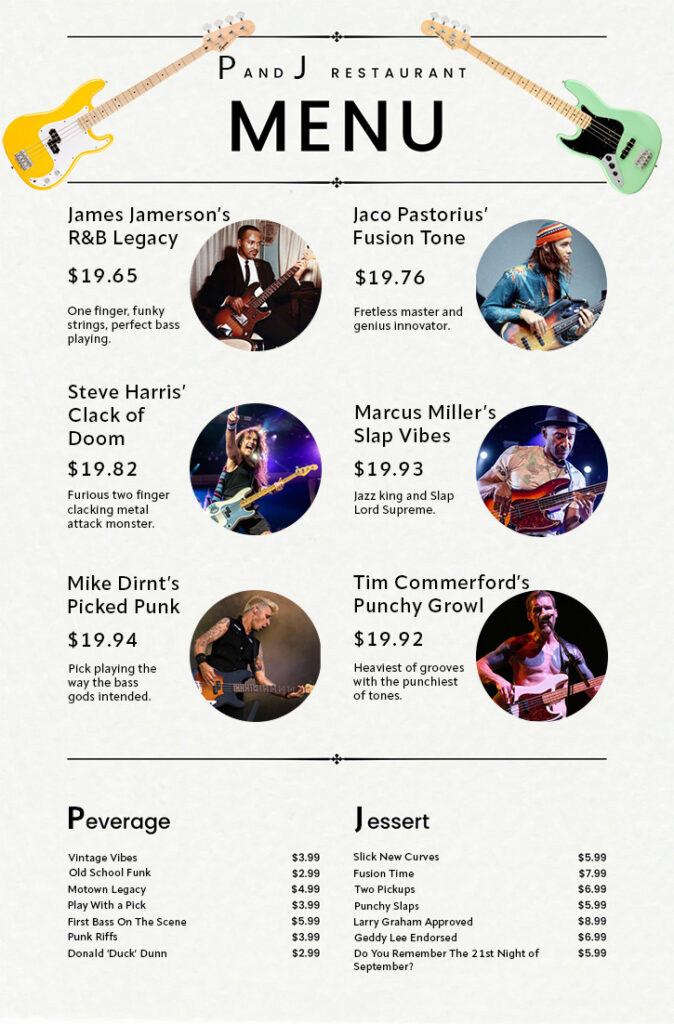
For the subjective guide you have to play to your tastes and loves.
For example – I love metal.
So – what then is the better bass for metal, J bass or P bass?
It Depends. (It doth strike again!! Egads, the omnipresent power of It Depends!!)
I’ll show you how annoying this question is by taking you on a little personal journey through my metal-loving bassist preferences.
To determine what bass will be best for metal, I have to figure out what kind of metal – out of the massive sub-genre pool – do I want to play. Stoner metal is way, way different from modern tech-metal, and I don’t even know what to do for death metal (but it should probably have lots of spikes on it, right?).
Ok.
So, what kind of metal do I want to play?
- I like big, thick, chuggy riffs like Sabbath and Red Fang.
If I investigate the style of bass they play I find…
- Geezer Butler, bassist for Black Sabbath, recorded the seminal album Paranoid on a ‘69 P bass.
Great!
Now I’ll look up an image search for ‘Geezer Butler Live’ to see what he plays when he’s out and about and I find…
Aw shit.
He’s playing all sorts of things. He’s playing a P bass sometimes, but he’s also playing all sorts of other weird unknown basses at other times.
I guess the P bass wins for classic recordings, but it looks like the PJ wins (more on this later) for his more modern live playing.
How about Aaron Beam from Red Fang?
Well, he records and plays with an 80’s G&L P-bass style bass.
Thanks for the consistency, Aaron!
So, from this I guess I’m going for the P bass, right?
It seems to be my common denominator for the bands and sounds I like to hear in the metal that I like to play.
But what about other kinds of metal?
 What if I was a Judas Priest and Metallica maniac? What would I do then?
Well, Ian Hill from Judas Priest is out and about playing a signature P-bass style instrument right now…
But in his career he’s played J bass and all sorts of other variations.
Metallica is even harder to pin down.
In the Cliff Burton era (RIP Cliff) it was all Rickenbackers, and then when Jason Newstead joined he played more modern custom-type instruments with all sorts of variations and now, with Robert Trujillo, it’s another giant variety of instruments.
We can do this for just about every genre.
I love punk, but do I get a P bass because I love the Ramones, or do I get a J bass because of Bad Brains, or do I go get something totally different because of Fugazi?
Can you see how the great big, murky clouds of it depends stretch across your bass-judging horizon?
How do you figure out what bass is best?
How do you figure out what bass is the best bass for what you want to do and sound like??
Well, lucky for you – I made this flow chart.
And if the flow chart didn’t convince you…
Get your keys.
It’s time for….
A Trip to the Music Store

Because what we each like is so subjective, because basses are so different from one another and because – even within a given genre – the bass choice is going to be different, you have to get your hands and ears on these things in real life.
Get yourself to a music store and PLAY these basses!
I know this isn’t feasible or even possible for everyone, but if you can make it happen, do it!
It’s one thing for me to tell you about the different necks of these basses and how each one can feel different for better and for worse. It’s a completely different and altogether better thing for you to go out and figure this out on your own.
If you can’t make it to the music store, Josh has thoughtfully provided the next best thing.
And in addition to Josh’s video, you can find great interviews and live footage and endless product demo videos out there that can help you figure out what basses speak to you.
OK.
So you get to a music store, you check out the live footage, you watch players talk about their gear, you watch the product demos and you see…
Fender P basses? Sure.
Fender J basses? Also, sure.
But you’re also going to see… (dun dun DUN!)
…other basses.
*gasping* What??? There are other basses??
Indeed there are. Lots of them.
But this article is only about P and J basses, so they all get left out.
However, there are some other basses that do need a mention in this article.
#5P and J Basses That Aren’t Fenders
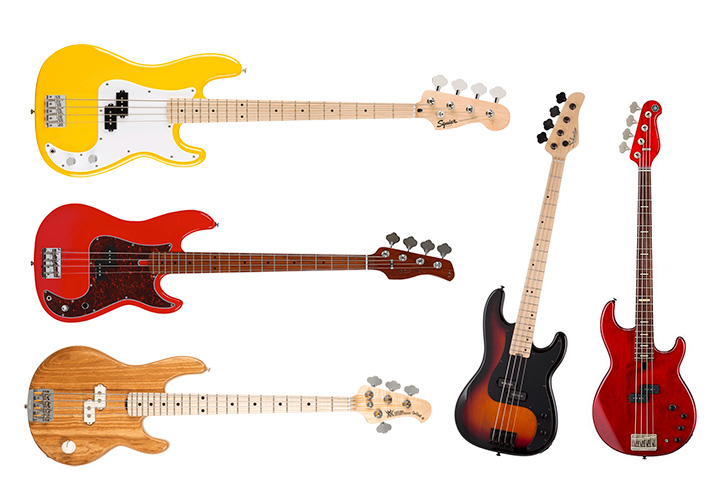
There are P basses and J basses that aren’t Fenders.
The basic design, sound and model of the Fender Precision and Jazz bass are so archetypal and iconic that many (read: almost all) other manufacturers have their version of these basses.
You can tell what’s a P-bass copy and a J-bass copy by referencing the field guide.
The most instant and obvious giveaway is the number of pickups and their placement.
If you see one pickup split into two offset rectangles in the middle of the body, it doesn’t matter the manufacturer, that’s a Precision-style bass.
Likewise – any bass with two long rectangular pickups – one in the middle of the body and one way back toward the bridge – is a Jazz-style bass.
Quick side note: This is also helpful info if you’re ever shopping for PICKUPS for a bass as pickup manufacturers also identify their pickups as P or J style pickups.
Are these basses by other instrument makers better or worse than the Fenders?
You know what I’m going to say to this already.
It depends on what you like.
A solid hour in a moderately well-stocked music shop should provide this answer better than any words I could ever type.
There’s only one more question I can anticipate.
The question asked by some mad-scientist-turned bass player many years ago.
“What if,” this character asked, bathed in the fluorescent glow of test tubes and weird mad-sciencey junk “we combined the P bass with the J bass? Mwua Ha ha HAAAAA!!!”
This rather astute question was overshadowed by the trappings of mad-science stuff in the scene… but…
What if indeed?
#6P/J Combo Basses
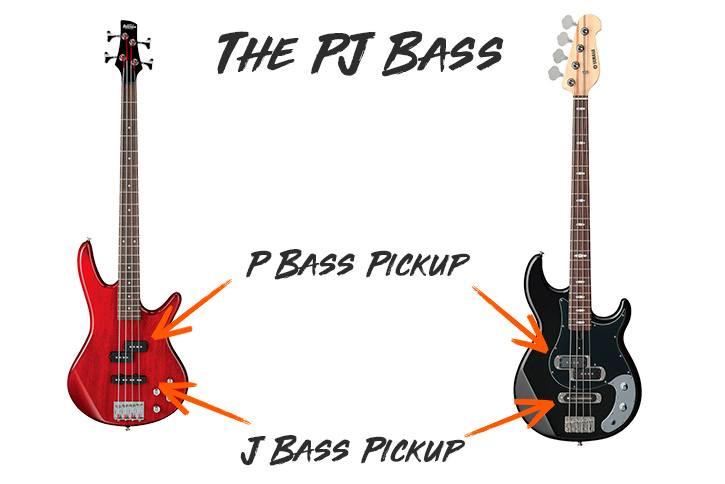
If the P bass vibe and sound comes from the perfect placement of that split pickup right in the center of the body…
And if the J bass special magic sauce comes from that long rectangular pickup way down by the bridge…
What if you made a bass with a P bass pickup in the middle and a J bass pickup by the bridge?
These basses are familiarly called PJ basses, and they look like that photo above.
These basses seem to offer the very best of both worlds, right?
Right.
So why am I not championing these basses as the solution to the problems of the world? As the olive branch to, finally, bring peace between the warring tribes of P and J bass fundamentalists?
I… don’t actually know.
They’re just not the classic bass.
They make great sounds, just like P basses and J basses. Do they make the exact same sound? Maybe? Kind of?
I took a morning in a music store recently and played 4 or 5 PJ basses to research this portion of the article. I couldn’t figure out why I owned one P bass and one J bass and zero PJ basses.
All the PJ basses I played sounded good.
Fenders, Yamahas, random brand used things – all pretty good.
They had elements from both the P bass world and the J bass world.
What, then, led me to buy two specialized basses instead of one combo bass???
I still don’t know, but I’ll leave you with my guesses and you can do with it what you will.
The PJ combo bass seems more like a swiss army knife approach to a bass – one bass to do it all.
Having each bass on its own feels like I have specific, specialized tools: a solid knife, a great pair of scissors, a reliable saw, a set of well-manufactured tweezers – rather than a convenient combination of all of them.
If I was on a budget and just starting out, would this be a good option?
Absolutely.
Is Geezer Butler of Black Sabbath out there playing a PJ bass right now? Yes. Absolutely.
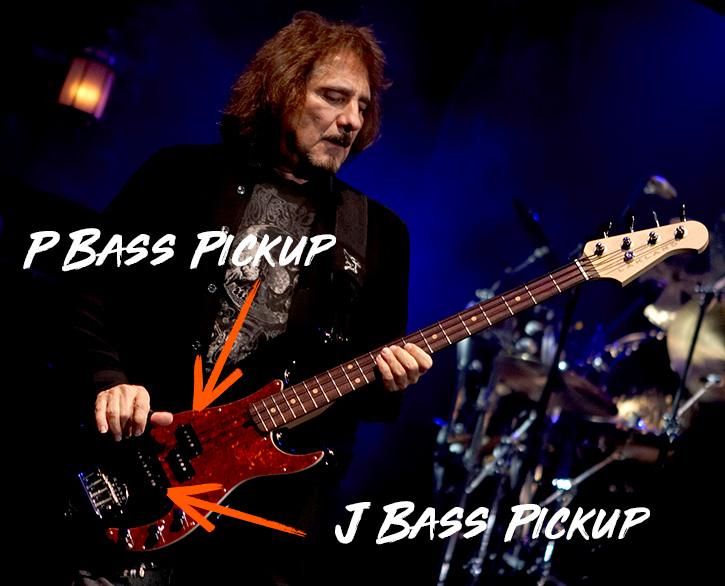
I bought my P bass and J bass way late in my bass playing career as a direct and focused response to needing the bass tools that bands, producers and sound engineers wanted and expected me to have.
And I was an adult and I could – over time – buy one of each of the specialized tools I needed.
 If you’re just starting out on a budget and you find a PJ bass that sounds good and feels good to you, congratulations, godspeed and huzzah, I say to you.
If you’re a seasoned pro (ahem, Geezer Butler) and you find the PJ sound and feel works for you, fantastic. Get it.
Who am I to criticize the bass choices of The Geezer?
Outro
You can’t feel, heft and play a bass through the internet… yet.
So until you can, this is as much as you’ll ever need to get familiar with the legendary Precision and Jazz basses: their history, their recorded and legendary sounds, their identifying characteristics, their differences, their clones and their combination.
If you love films you’ll hear people talking about Scorsese and Kurosawa.
If you like comics you’ll hear people talk about Kirby and Eisner.
If you like baseball you’ll hear people talk about… famous baseball players.
Bass players talk about Ps and Js.
Welcome to the conversation, my fellow bassist.
Now go out, and get your mitts on as many of these instruments as you can.
*It wasn’t, actually, the first electric bass. Someone else made one in Seattle† before Fender did, but it didn’t catch on.
From GuitarWorld:
“Contrary to popular belief, Leo Fender didn’t actually create the first-ever electric bass guitar. That honor goes to Paul Tutmarc, a musician and inventor from Seattle, Washington. Tutmarc developed his take on a bass-like instrument way back in 1935, a whole 16 years before Fender would officially launch the famed Precision Bass.”
**Unless you’re Anthony Jackson. It totally worked for him.
†Figures, right? Those Seattleites are always up to groundbreaking things up there. Electric basses, Grunge, world-dominating coffee franchises…
 Beginners Course

 4 easy steps to pro fretting and plucking
Comments
Got something to say? Post a comment below.